You cannot decouple a rainforest from the planet.
Every year, roughly 22,000 tons of phosphorus-rich dust crosses the Atlantic from the Sahara Desert to the Amazon Basin. Without it, the Amazon – the world’s largest rainforest – would slowly starve. The desert feeds the forest. One of nature’s many perfect symphonies, as Erin Remblance recently described it, demonstrates why we cannot conserve the Amazon by drawing a boundary around it. Resilience is not a property possessed. It is a relationship that spans an ocean.

The Choluteca Bridge in Honduras was engineered to withstand anything. When Hurricane Mitch hit in 1998, it survived, perfectly intact. But the river changed course. The roads vanished. A superb bridge over nothing, leading nowhere.
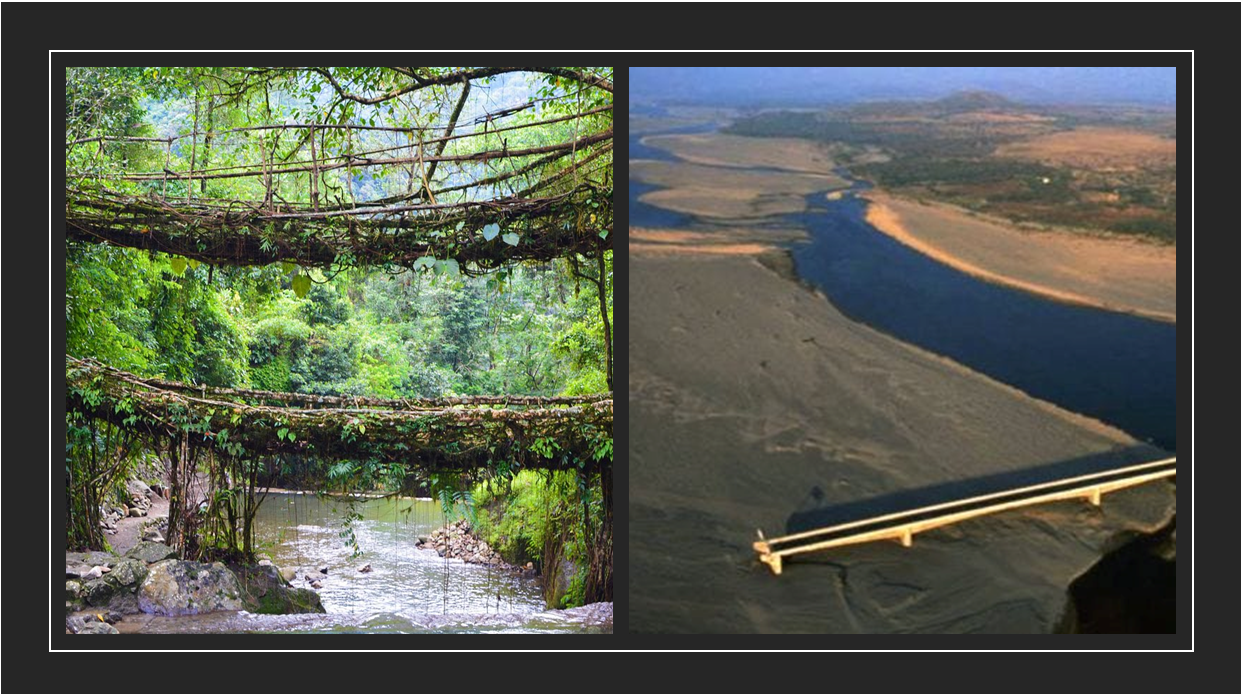
In Meghalaya, the Khasi people grow bridges from the roots of rubber fig trees. The Umshiang double-decker root bridge took decades to form. It strengthens over time. It adapts to monsoon floods. It has been functioning for centuries. It is not built. It is grown. It is alive.
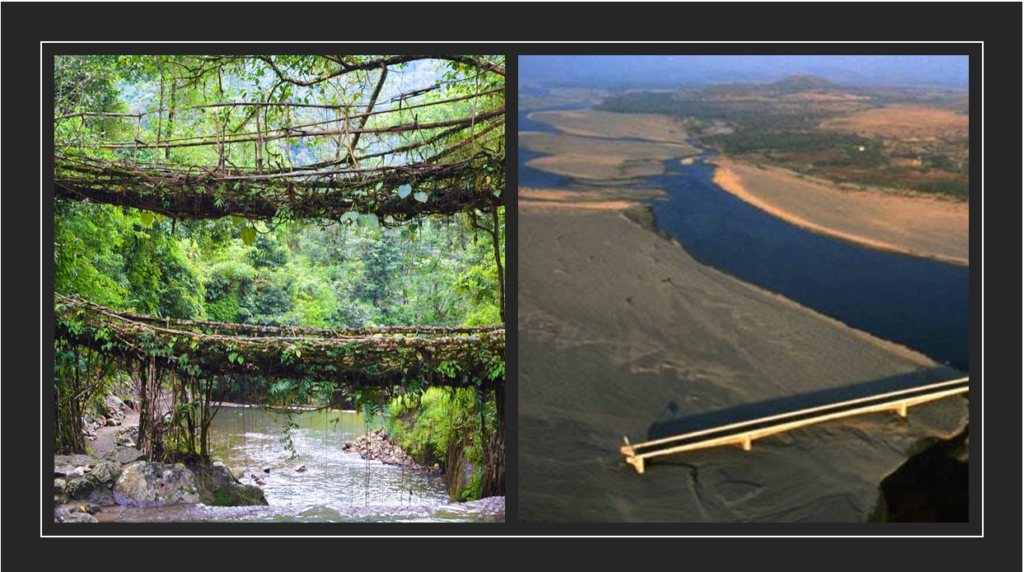
Image: The Umshiang double-decker root bridge, Meghalaya / Choluteca Bridge in The Honduras
These two bridges reflect perspectives of resilience on a continuum from endurance and persistence to metamorphic transformation. It is a distinction that resilience scholars have increasingly recognised and one that we have been reflecting on – following sustainability thinking – as weak versus strong resilience. Whether engineered to absorb shocks and return to baseline on the one hand, or systemically transformative through relational interdependence with nature on the other. This continuum draws on emerging work challenging individualistic resilience frameworks, recognising that resilience is, at its core, relational.
Weak resilience prioritises “bouncing back” – stability, recovery, return to baseline. It is, in Indy Johar’s terms, entropy dressed as safety: systems driven toward homogenisation and exhaustion. Strong resilience, in contrast, recognises that living systems don’t necessarily return; they co-produce new pathways. “Life acts as a counterforce to entropy,” generating multiple routes to resilience where context compensates for individual deficits. The system’s intelligence resides not in any single node but in the interaction architecture.
The root bridge doesn’t bounce back. It grows forward.
This is the distinction at the heart of Johar’s recent Long Now talk on civilisational optioneering. Civilisation’s longevity depends not on brittle stability or efficiency, but on optionality – the surface area of future freedom. Like Choluteca: strong, rigid, perfectly designed for a world that no longer exists. What we need are living systems – ‘exstitutions’ and governance architectures that strengthen through use, adapt through relationship, and grow more resilient over time. “Open gardens” where success is measured by the system’s ability to evolve.
In our recent article reflecting on risk reductionism, we argued against ‘tidy lists’ for risk and resilience – how rankings might actively misrepresent the nature of danger. They present entangled, cascading crises as separable items for separate ministries. What they conceal is what the Sahara-Amazon phosphorus cycle reveals: risk travels through relationships, and so does resilience. The breakdown of one system alters the likelihood and impact of all the others.
This is why optionality for everyone is strategic necessity, not idealism. When optionality breaks down anywhere, it cascades everywhere. A civilisation that forecloses options for some forecloses them for all. It just takes longer for the consequences to arrive.
And this is why the civilisational options fund’s central provocation represents something fundamentally different from traditional security thinking: it reframes resilience not as hardened boundaries and military strengthening, but as the capacity for human thriving. Security rooted in relationship, not fortification. Root bridges, not Choluteca.
The wax is what is said; the gold is what is meant. One must yield for the other to shine.
Johar’s talk may be full of wax – the entangled and cascading nature of the polycrisis, the institutional architecture, the systemic arguments, the governance redesign. Important wax. Necessary wax.
But the gold is in his final question, and it is disarmingly simple: Do we want to live? And, if so, what value do we place on being human?
The Choluteca Bridge sought to preserve the bridge. The Khasi seek to preserve the relationship. These are not the same thing. If humans are units of production, resilience means keeping the machinery running. If humans are something more – sources of care, of meaning, of relationship, of creative possibility – then resilience means preserving the conditions under which we can flourish in ways we cannot yet predict. It means keeping the garden open.
There is no pathway to conserve our current trajectory to the future. The question is not how we make our structures stronger. The question is how we make them alive.
• • •
These threads – civilisational optionality, relational resilience, planetary governance, and the question of what we are ultimately wanting to preserve – are converging across our 2026 Wax and Gold Open Dialogue series. We’d love you to join us:
March 3rd at 2pm GMT: Resilience: From Must Knows to Must Dos – with the Stockholm Resilience Centre, Global Resilience Partnership, SEEDS India, African Climate Development Initiative, and Susanne Moser Consulting.
March 10th at 3pm GMT: What holds us together in a world falling apart? – with Adam Kahane and Betty Sue Flowers on collaboration across difference.
• Indy Johar’s Long Now talk on Civilisational Optioneering
• Erin Remblance on why the Amazon wouldn’t exist without the Sahara
• Our article on the dangers of risk reductionism and ‘tidy lists’
• * ‘Exstitution’ is a term from Johar and others at Dark Matter Labs