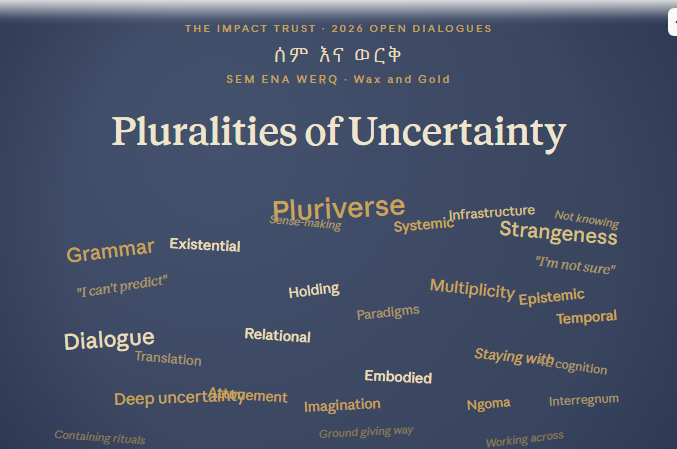
A follow-on dialogue continuing April’s conversation on Deep Uncertainty and the Grammar of Risk
The invitation
On 14 April, Deep Uncertainty and the Grammar of Risk opened a question that did not close. When the grammar of risk fails and we find ourselves in the territory of deep uncertainty, what are we actually talking about? The dialogue surfaced, implicitly more than explicitly, that uncertainty is not one thing. Many different forms of it were pointed toward across the conversation: existential, systemic, relational, objective, subjective, the uncertainty that comes from not being able to predict a complex system, and the uncertainty that comes from not being sure about oneself.
This follow-on dialogue takes up that thread directly. Rather than moving quickly to resolve or reframe the plurality, it invites us to stay with the differences, and to ask what kinds of judgment, attunement, and collective practice each form of uncertainty calls forth.
“Deep uncertainty is ‘I’m not sure’ versus ‘I can’t predict what will happen.’ Different kinds of uncertainty.” (Joan Lurie)
Joan argued that the answer to uncertainty is not the individual cultivation of comfort with not-knowing, but uncertainty infrastructure designed into collective life: containing rituals, practices, and constraints that allow organisations, communities, and societies to hold uncertainty as a condition rather than manage it away as a problem. If the grammar of risk is a set of rules, what is the grammar of uncertainty?
Steven Segal offered the distinction between objective uncertainty (located in situations outside us) and subjective uncertainty (the ground giving way beneath one’s own sense-making), and closed with the phrase that haunted the rest of the session: “the anxiety of the strangeness of the other,” and the task of working across paradigms without collapsing that strangeness into the same. Writing after the dialogue, he proposed that a follow-on session focused on drawing out the plurality of uncertainties, and on what each calls forth, might open something the first conversation could only gesture toward.
What this dialogue looks to surface
The first dialogue surfaced that we do not yet have shared language for what we are actually in. “Uncertainty” is doing the work of too many distinct things at once, which is part of why institutional responses keep defaulting to the grammar of risk. The plurality is not a complication to be resolved but the territory to be mapped. Four questions sit at its centre, each a different doorway into the territory:
What are the different forms of uncertainty we are actually inhabiting? Existential, systemic, relational, epistemic, embodied, temporal. Is there a plural grammar of uncertainty that does not reproduce the reductionism of the very lists this series has critiqued?
What kind of judgment, attunement, and action does each form of uncertainty call forth? An existential uncertainty asks a different response than a systemic one; a relational uncertainty asks something different again. What are these different modes?
What are the containing rituals, practices, and infrastructures, whether in organisations, communities, or knowledge traditions, that allow uncertainty to be held rather than managed away? Drawing on Ngoma, on 4E cognition, on organisational systems work, and on the contemplative traditions.
What does it mean to stay with the strangeness rather than collapse it, to work across paradigms without forcing them into one?
Conversation guides
Four practitioner-scholar registers each working with uncertainty from a different direction, held together by the shared recognition that came through the first dialogue: that the plurality is the point, and that staying with it is the work.
Nicola Robins (Incite; Vondo lineage of Ngoma), holding the practitioner register of working with uncertainty as a living tradition. Co-founder of Incite, a sustainability advisory firm based in South Africa, and author of Diviner Mind: How Organisations Can Learn from the Indigenous Science of Uncertainty. A graduate of the Yale School of the Environment and senior associate of the Cambridge Institute for Sustainability Leadership, she has spent over two decades working with leaders and teams in emerging markets across Africa. She is also a practising diviner in the Vondo lineage of Southern Africa’s Ngoma tradition – a knowledge system she has applied for more than twenty years within the world of business. Her work bridges complexity science with the cognitive technologies of indigenous African traditions. She brings a dual provocation: the pragmatic question of how to find the “rightful place” for conventional risk tools without being captured by them, and the deeper inquiry into what indigenous sciences of uncertainty can teach us about navigating the unknowable. As she writes: “control was always a mirage.”
Antony Malmo (organisational ecology), holding the applied question of how teams and leaders move from prediction to preparation, probabilities to possibilities, models to imagination. Working on transformation and adaptability for radically uncertain futures. Based in Australia, his work focuses on multi-systemic resilience, drawing on psychosocial hazard management, systems thinking, and the emerging literature on deep uncertainty. His provocation in the Risk Reductionism thread was direct: that our risk tools function as emotional crutches preventing us from confronting the depth of what we don’t – and can’t – know. Before we can discuss risk honestly, he argues, we need to examine our collective relationship with uncertainty itself.
Steven Segal (philosophy and psychology, Sydney), holding the taxonomic and existential register, and the work on anxiety, paradigms, and the strangeness of the other. Dr Steven Segal is a psychologist and existential leadership coach based in Australia, specialising in the development of emotional and existential wisdom in therapy, leadership, and professional practice. He is the author of two books on leadership and the editor of two additional volumes, and previously served as an Associate Professor at the Macquarie Graduate School of Management. His forthcoming book, Mandela’s Leadership Legacy: Emotional and Existential Wisdom, explores the leadership of Nelson Rolihlahla Mandela as a lived response to existential threat, integrating philosophical, therapeutic, and strategic perspectives.
Joan Lurie (organisational systems), holding the question of uncertainty infrastructure at the scale of the collective, and the paradoxical recognition that the drive for certainty is itself a source of risk. Joan’s work integrates strategy, systems thinking, complexity and adult development theory. Her insights into organizational ecology have been developed through both internal corporate as well as consulting roles, helping teams and companies achieve turnaround results – emerging new cultures, operating models and different organisational systems, whilst simultaneously building their adaptive capacity. Joan’s Orgonomics™ methodology transforms ways of seeing and knowing; reframe assumptions and mental maps and repattern systems for new ways of relating and operating, to achieve coherence and higher order functioning and performance.