A provocation for an Open Dialogue in design coming soon
By chance, a supper conversation last week turned to the question of an enough number. Someone spoke of a small family foundation built around the question: how much is enough, enough capital, enough years, enough to live well. And what is the rest for?
Enough turns out to invite the same questions as resilience: enough for what? Enough for whom? Enough at whose cost? It refuses to answer until you put a measure of purpose under it. That measure is what the modern economy was built to obscure.
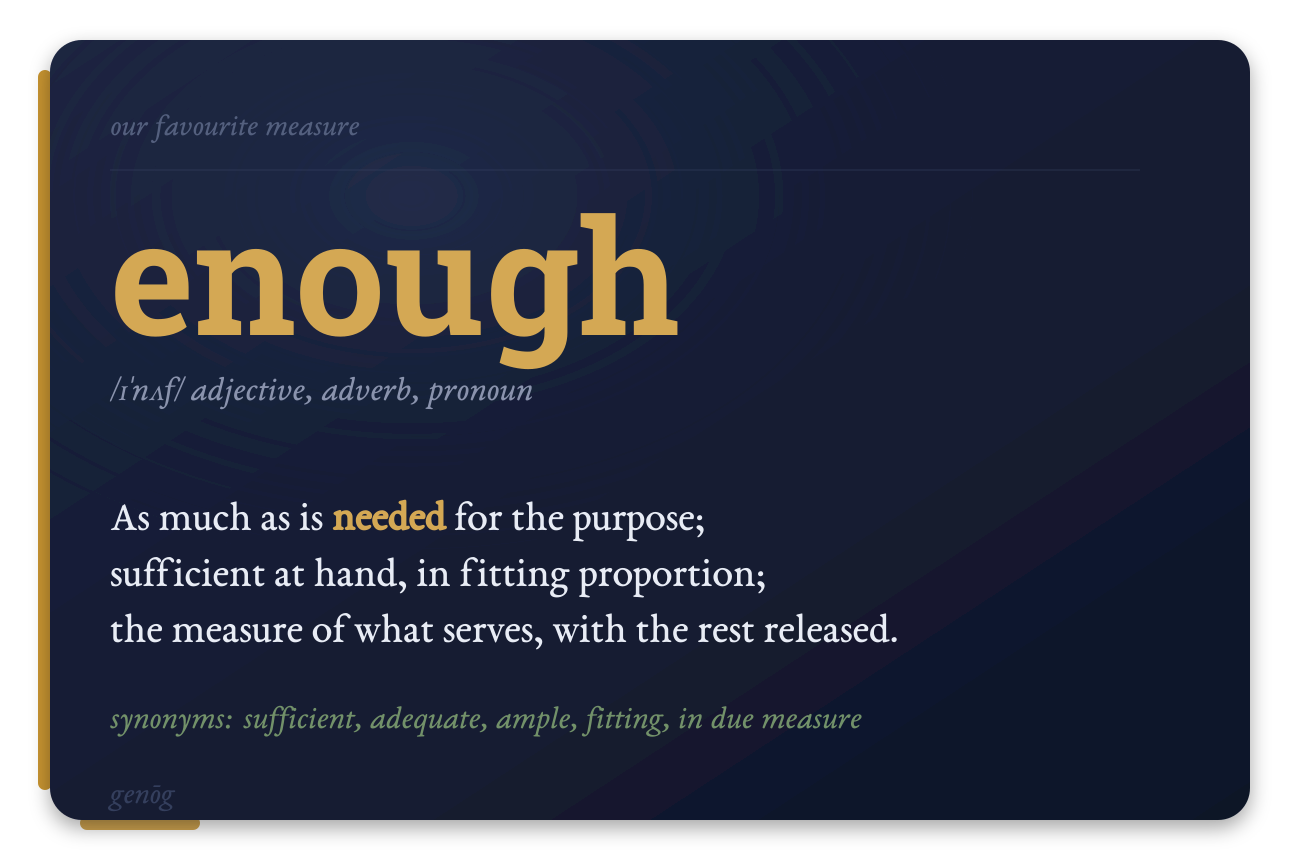
The word itself remembers what we have forgotten. Genōg in Old English, ganōga in Proto-Germanic. The root sense is at hand, sufficient for the purpose. You cannot say enough without an implicit horizon: enough for what, for whom, toward what end. To speak of enough is already to admit there is something the more is for. Something beyond itself.
Enough seems to be a word we use but never really mean. This is not by accident. We have built an entire economic order based on the message that what it points to does not exist. That growth must be perpetual. That accumulation needs no justification beyond itself.
But the word is beginning to be spoken aloud again.
At the table, someone put it plainly: the economy as we know it was not designed for people or for planet. It was designed to respond to capacity of industrial production. The institutions, the metrics, the time horizons, the very grammar of value. All of it was built to organise an extraordinary capacity to extract, refine, manufacture, and distribute.
After the second world war, that capacity had been built to a scale no peacetime economy could absorb. The factories could not simply stop. The problem became: how do you keep all of this running when human needs are finite?
The answer was to manufacture wanting. Edward Bernays had already shown in the 1920s, applying his uncle Freud’s theory of unconscious desire to public relations, that wants could be sold to people as needs. After 1945 the technique was industrialised. One pair of shoes had to be made to feel inadequate. The car had to be replaced before it broke. The kitchen, the wardrobe, the holiday, the self, all perpetually upgrading, because the factories had to keep running. Adam Curtis tells this story in The Century of the Self: the deliberate engineering of insatiability as the operating system of consumer capitalism.
This is what required enough to stop being a measure of purpose. The system did not need a logic that permitted people to stop wanting. It needed a logic that ensured they never could. What was sold was the conviction that just enough was a precarious place to stand, that the ground beneath it could give way at any moment. Manufactured scarcity inside apparent plenty. The profit motive runs on top of this machinery. It is not its cause.
Aristotle saw the philosophical version of this coming twenty-three centuries ago. He distinguished oikonomia, household management for the sake of living well, from chrematistike: the art of acquisition for its own sake. He thought unlimited acquisition was a category error: the means had outgrown the end it was meant to serve. Keynes saw it too. In 1930, in his essay Economic Possibilities for Our Grandchildren, Keynes predicted that productivity would solve the economic problem within a hundred years and that humanity would then have to confront what life was actually for. He thought we would have reached that point around now.
We did. We just don’t act as if we have. The technology of manufactured wanting is what kept us from noticing.
There is a threshold past which a useful tool becomes a destructive one. We crossed it some time ago. The machinery of perpetual dissatisfaction, once a way of keeping post-war production running, has become the logic that threatens the conditions of life itself. The same engine that pulled hundreds of millions out of agrarian poverty is now driving the planetary boundaries past breaking, and concentrating wealth at a velocity that no democratic settlement can absorb.
This is what makes the principle of enough not a moral preference but an existential question. Without it, the system has no stopping rule. And a system with no stopping rule, applied to a finite planet, is an extinction machine.
The deeper problem is not that we lack the answer. It is that we have been taught not to ask the question.
The Stiglitz-led G20 Inequality Report, commissioned under South Africa’s presidency and the first such report in G20 history, was quietly removed from the G20 website when the United States assumed the presidency. The data was not contested. The methodology was not challenged. The report was simply made to disappear. What was being erased was not a finding but a question: whether there is any threshold past which more becomes too much.
The same logic that removes the report is the logic that says no number can ever be enough. Both rest on the same refusal: to permit the existence of a measure against which wealth could be assessed as sufficient.
Without a measure, there is no sufficient. Without the sufficient, there is no enough. Without enough, there is no rest of it. No portion that belongs to anyone or anything else.
There is a small family foundation called Be The Earth. Founded in the United Kingdom, working primarily in Brazil and South Africa, it runs on what its founders call a closed-loop model: investments and philanthropy held under a single vision, all profits either reinvested to mission or given. Their distinctive practice is to ask, openly, what their enough number is. How much capital is enough to do the work. How long the foundation should exist. Whether more wealth is needed to do more good, or whether the chase for more wealth is itself the thing that corrupts the good.
The questions are not rhetorical. They reorganise the practice. Once you have named what is enough, you have forfeited the comforting ambiguity that lets accumulation continue indefinitely. You have made the rest of it visible. And the rest of it, what was previously hidden inside the word growth, turns out to be available for redistribution, for regeneration, for return.
This is what Ingrid Robeyns is arguing for at the level of political philosophy: limitarianism, the case for a structural ceiling on wealth above which more is morally illegitimate. A family foundation that adopts an enough number is, in effect, practising voluntary limitarianism. Exemplary rather than systemic. But if enough families, enough institutions, enough holders of capital began to ask the question publicly, exemplary begins to shift what counts as normal.
There is also something else at work in Be The Earth’s practice. They speak of trust-based, relationship-driven funding, decisions held by people with lived experience, feminine principles of leadership. This is not philanthropy with love added as decoration. It is philanthropy reorganised around love as the load-bearing element, what Kirsten Dunlop calls love as infrastructure. The enough number is what makes that infrastructure possible. As long as accumulation is the operating logic, love can only ever be ornamental. Once enough is named, love becomes structural.
The principle of enough is not austerity. It is not a vow of poverty, not a moral aesthetic, not a renunciation. Nature is not austere. Forests do not hoard their fruit. Rivers do not stockpile their water. Mycelial networks do not accumulate. They release, they prune, they compost, and the releasing is what makes the abundance possible. Enough is the precondition for flourishing, not its negation.
The principle of enough simply asks the question that the economic order was built to suppress: what is the wealth for?
It asks it of governments, who have been allowed to treat GDP growth as a proxy for collective wellbeing for so long that the proxy has eaten the thing it was meant to measure. It asks it of corporations, whose fiduciary duty has been narrowed to a single metric while the world they depend on burns. It asks it of philanthropy, which has been allowed to mistake the preservation of the corpus for the pursuit of the mission. And it asks it of each of us, individually, because the answer cannot be wholly outsourced to policy.
What is your enough? And what is the rest of it for?
These are not abstract questions. They are the questions that determine whether the next century is one of regeneration or extraction. They are the questions a foundation can put at the centre of its governance. They are the questions a family can ask around a supper table. They are the questions a society can put to its institutions, if it remembers that it has the right to ask them.
The economy as we have inherited it was built to make these questions disappear. The work now is to put them back.
Enough is the third in a series of provocations, following Earned and Essential, preparing the ground for an Open Dialogue in the Wax and Gold 2026 series.
Be The Earth Foundation. The closed-loop model, the enough number practice, and the trust-based funding philosophy described in the foundation’s own words. betheearth.foundation
EDGE Funders Alliance, “Giving With Both Hands: Aligning Investments and Philanthropy Under the Same Vision.” A public conversation with Be The Earth on what asking the enough number question means in practice. edgefunders.org/giving-with-both-hands
Adam Curtis, The Century of the Self (BBC, 2002). The four-part documentary chronicling Edward Bernays, the Freud connection, and the deliberate engineering of insatiability as the operating system of consumer capitalism. Available at archive.org/details/the-century-of-the-self-adam-curtis.
Ingrid Robeyns, Limitarianism: The Case Against Extreme Wealth (Allen Lane, 2024). The political philosophy of the structural ceiling: why no one should hold more than a defined amount, and what changes when the question is asked at the level of the system.