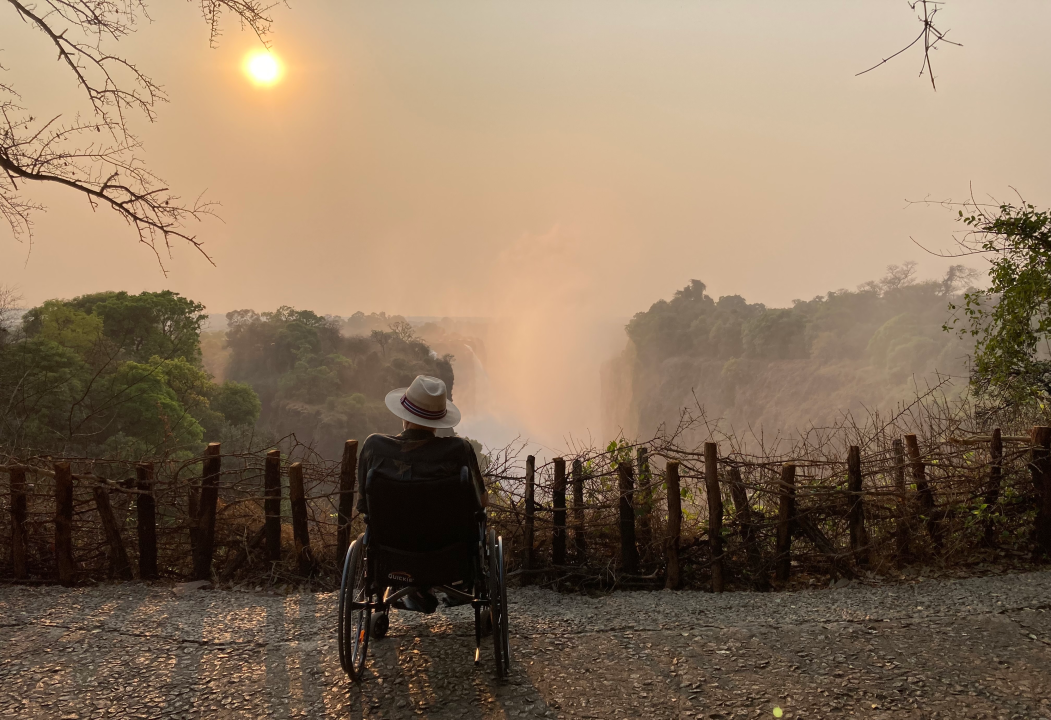
Mike Freedman died on Thursday April 23rd. For more than two decades he was a companion of mind, a founding shaper of our work, and a dear friend.
I first met Mike in early 2004, when he brought his exceptional craft as a brandmaker and storyteller, along with his generosity, to GreaterGood. He had a rare kind of clarity, the kind that could hold a plethora of ideas open long enough for what mattered to surface. He went on to serve as founding chair of the Impact Trust, and more recently helped us sharpen our language around the work of collective resilience. The words we now use to describe this work are, in no small part, his gift to us.
Between those bookends was Routes to Resilience – and, at its heart, the “Finding Why” visioning session Mike convened. A generation of young people passed through that room and met themselves a little more clearly on the other side of it. That was Mike’s particular genius: holding a conversation open long enough for a person, a team, or an organisation to find their own purpose inside it and then finding language for it that would travel.
Mike had a way of inverting questions so that you heard them again for the first time. In one of his Almost Haikus, titled 2 Questions, he turned his own Finding Why practice on its head:
2 Questions
Why
the second deepest question
Why not, first
Must you ask why?
Why not?
On 1 January 2022, he set me a quieter challenge: a year of resilience in haikus – one a day, combining inner and outer nature. My first was titled no mud, no lotus. It broke his 17-syllable rule. He wrote back: distil your thoughts.
He was the encourager of that distillation. He didn’t only prompt it; he held me to it, one day at a time, for a year. Every careful narrowing from noise to signal since, including as I have been writing up my PhD thinking, has a line back to those 17 syllables.
Mike was less a teacher than a clarifier, and I think that is an important distinction. He worked with what was already there – in a person, a team, an enterprise, a place – until its shape became visible to the people inside it. He believed strong cultures cascade into strong brands, and that shared purpose sits at the root of both – and he meant that not only for enterprises and places, but for young people, for neighbourhoods, for friendships. He valued curiosity, co-creation, and care, and he brought them to every room he entered. He had a way of sensing what sat beneath the surface of a conversation, and of asking the question that moved it forward, without ever needing to be the one who moved it.
And then there was Mike on the page. His weekly Fragments were exactly that – small, observant, unhurried, the kind of writing that trusts the reader to meet it. He noticed. He named. He made a practice of turning pieces into something whole by paying attention long enough for the pattern to show itself rather than forcing it.
What endures is quieter and harder to name. Mike encouraged me, as a person, and in my leadership of this work, to always stay open to the why and the why not. That openness, the generosity of thought and the discipline of attention it asks of us, is a standard he held, and one I will seek to keep.
I will miss him profoundly.
Mike, of course, left his own last word:
Afterlife
Then when I am dead
Keep the praise-singers away
Honour my weakness