Ended
📅 Join the next one.Because the next ten years will very likely define the next ten thousand
Tuesday 9 June 2026 | 2.00–3.30 UK | On Zoom, open to all
Hosted by the 4th International Conference on Environmental Peacebuilding, University of Ottawa. Register here.
This roundtable continues a line of inquiry that The Impact Trust and Dark Matter Labs have been developing together over the last eighteen months, exploring Antarctica as a generative site for thinking through pre-emptive peace at planetary scale. Earlier conversations in this thread have taken place within the Wax and Gold Open Dialogue Series and in ongoing collaboration with Indy Johar and the Civilisation Options Fund team, drawing in voices from Antarctic science, institutional stewardship, philanthropic practice, and systems design. The 4th Environmental Peacebuilding Conference provides a new venue to open this inquiry to the wider peacebuilding community, to test its resonances against the field’s existing expertise in cooperation under contested conditions, and to begin seeding what may be the first polar-focused strand within EnPAx.
Antarctica is Earth’s only legally constituted planetary commons, and a planetary systems stabiliser whose cryosphere shapes sea-level trajectories, ocean circulation, weather volatility, food security, and the insurability of coastal cities worldwide. What happens to the ice sheet is entangled with every delta, every island nation, every sovereign balance sheet, every insurance system on Earth. A 4.5-metre sea-level rise is not an abstraction. It is the Netherlands. It is Vietnam. It is India losing its monsoon season as the loss of the Agulhas current reshapes the system. Stabilising the cryosphere is equivalent to stabilising coastal sovereignty, protein flows, and the insurability of cities. As one of the participants in this roundtable has put it, Antarctica is “humanity’s family refrigerator.” It is on the blink. And we do not fix refrigerators after they fail.
Yet the Treaty System that governs Antarctica faces mounting strain as strategic competition intensifies ahead of the 2048 Madrid Protocol review. The Treaty was designed for demilitarisation and conservation, not for active planetary stabilisation. Built on consensus, it now operates through consensus paralysis: any party can block, and the language of “the system working as it should” becomes the language of nothing happening. The era of the gentleman’s game is over, and the world that made it possible is not coming back.
And conservation, in any case, is no longer sufficient. Conservation assumes a baseline that can be protected. That baseline is already destabilising. The question is no longer how to prevent disturbance; it is whether we can actively stabilise ice systems, ocean temperatures, and feedback loops. That question sits in controversial territory, raising geoengineering, large-scale intervention, and what one speaker has called “the Jevons paradox of climate”: if we make the behaviour cheaper to continue by putting out technological patches, we will keep doing it and keep piling on more.
This roundtable opens a further question that a pre-call discussion with the participants brought sharply into focus. Much of the last thirty years of environmental discourse has been a moral argument. And increasingly, there is no moral counterparty. No one is on the other side of the moral argument to be persuaded. A different conversation is now plausible, and necessary: one rooted in existential security, in the recognition that the losses from inaction are already large enough to reshape the geopolitical order, and in a serious reckoning with what governance forms could hold multi-agent coordination at planetary scale when the conventional international order is itself under profound strain.
Linda Sheehan (chair) is Executive Director of Environment Now, a California-based foundation supporting work on waterways, forests, climate, and rights of nature. She is the former Senior Counsel at the Leonardo DiCaprio Foundation, co-founder of the Earth Law Center, and a long-standing advocate at local, national, and international levels for nature’s rights, including invited expert testimony before the UN General Assembly.
Stephen Heintz is President Emeritus of the Rockefeller Brothers Fund, where he led the foundation’s long-term commitment to democratic practice, peacebuilding, and sustainable development. He brings decades of work at the intersection of philanthropy, multilateral governance, and institutional stewardship, and his perspective on the crisis of multilateralism bridges institutional innovation and the practical governance of global commons.
Indy Johar is co-founder of Dark Matter Labs and leads the development of the Civilisation Options Fund. His work focuses on the institutional, legal, and financial “dark matter” that shapes societies, and on designing organisational forms capable of holding trade-offs, building legitimate multi-agent coordination, and converting diffuse need into durable commitment under conditions of volatility.
Andrew Kelly is former CEO of the Antarctic Science Foundation, where he worked with around 300 research scientists across Australian and international Antarctic programmes. He brings direct knowledge of the Antarctic Treaty System’s structural challenges and advocates for emergence-based approaches to planetary governance. His perspective bridges the practical realities of Antarctic governance with deeper questions about deep time, consciousness, and human flourishing.
Environmental peacebuilding has traditionally centred on conflict-affected and post-conflict settings. This roundtable makes the case for a complementary orientation: governance designed to act before crisis rather than after. Three interconnected dimensions converge in Antarctica. Geopolitical peace, preventing resource competition from escalating into strategic confrontation as the 2048 horizon approaches. Ecological peace, stabilising the biophysical systems, ice sheets, ocean circulation, krill populations, on which global stability depends. And institutional peace, transforming governance frameworks before they fail under pressure.
The roundtable will sit as a genuine conversation across three registers that do not always meet. Andrew Kelly will open with what is actually happening on the ground in the Antarctic Treaty System, the practical realities of governance designed for one era trying to hold the pressures of another. Stephen Heintz will bring the register of institutional stewardship, the crisis of multilateralism, and the hinge moment philanthropy now sits in as $35 trillion moves between generations. Indy Johar will bring the provocation of what new institutional forms, middle-power alliances, ex-stitutions, planetary civic organising, could hold multi-agent coordination under existential strain. Linda Sheehan will chair, holding the space in which the rights-of-Antarctica movement and the broader rights-of-nature field sit as live partners to this conversation.
This builds on earlier conversations held in the Wax and Gold Open Dialogue Series on pre-emptive peace and on Antarctica as a planetary commons, and on ongoing work with Dark Matter Labs to develop pre-emptive peace architectures that move beyond traditional conflict resolution toward the deliberate design of political, regenerative, and financial frameworks for planetary commons governance. It builds, too, on the recognition surfacing across several of this year’s dialogues, from the Inequality Emergency to Deep Uncertainty, that the governance forms we have are not the ones we need, and that the work of imagining the next ones has begun.
The roundtable is held online as part of the 4th International Conference on Environmental Peacebuilding at the University of Ottawa (16–19 June 2026), and is open to all. Registration is free.
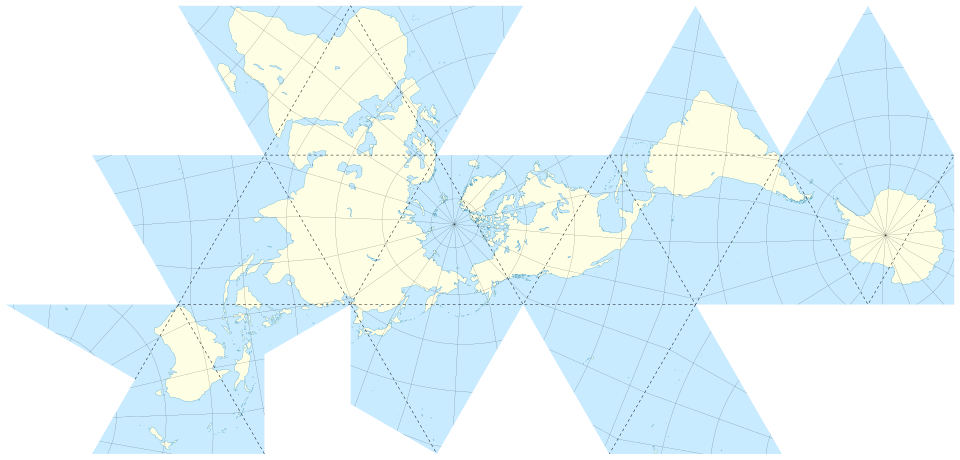
Image: Fuller’s 1954 projection shows Earth’s continents as one landmass with Antarctica at the centre of the frame. Image by Eric Gaba, CC BY-SA 2.5.